
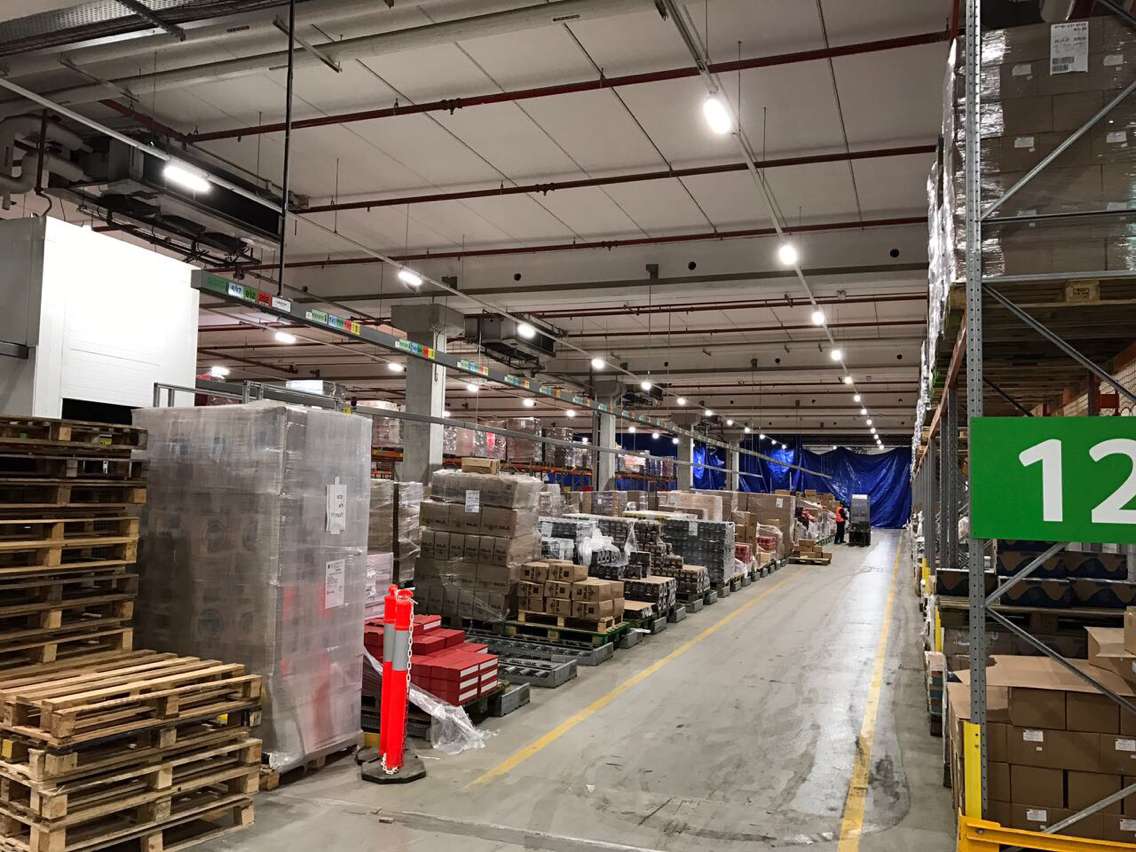

In industrial warehouse settings, LED high bay lights have quickly become the go-to lighting solution.
Choosing the right fixture is critical. This guide breaks down the key selection criteria for LED high bay lighting and offers practical advice on installation and maintenance.
Common LED High Bay Types and Key Features
1. Standard UFO High Bays (Round)
Named for their “flying saucer” shape, these fixtures feature highly integrated thermal management and strong central light output. They perform best in high-mount applications—typically 8 meters (25+ ft) and above—such as large distribution centers.
2. Standard Linear High Bays
With their elongated form, linear high bays are built for uniform light distribution. They’re ideal for long aisles and high-rack storage areas. Instead of concentrating light in a single point like UFO fixtures, they spread light evenly across the space, reducing shadows between shelving rows.
3. Dimmable High Bays
Fixtures that support 1–10V or DALI dimming allow output to be adjusted based on daylight availability, operating hours, or zone-specific needs. When integrated with building management systems, they can automatically reduce output in naturally lit areas during the day and switch to low-level security lighting after hours—delivering energy savings of 60% or more.
4. Sensor-Enabled High Bays
High bays with built-in microwave or PIR (passive infrared) sensors enable automated “lights on when occupied, dim/off when vacant” operation. Microwave sensors typically cover a radius of 8–12 meters (26–40 ft) and can detect movement through shelving, making them suitable for high-rack warehouses. PIR sensors rely on heat signatures and tend to perform better in enclosed environments like cold storage. Some models feature Zhaga-compliant interfaces, allowing plug-and-play sensor upgrades for future smart lighting integration.
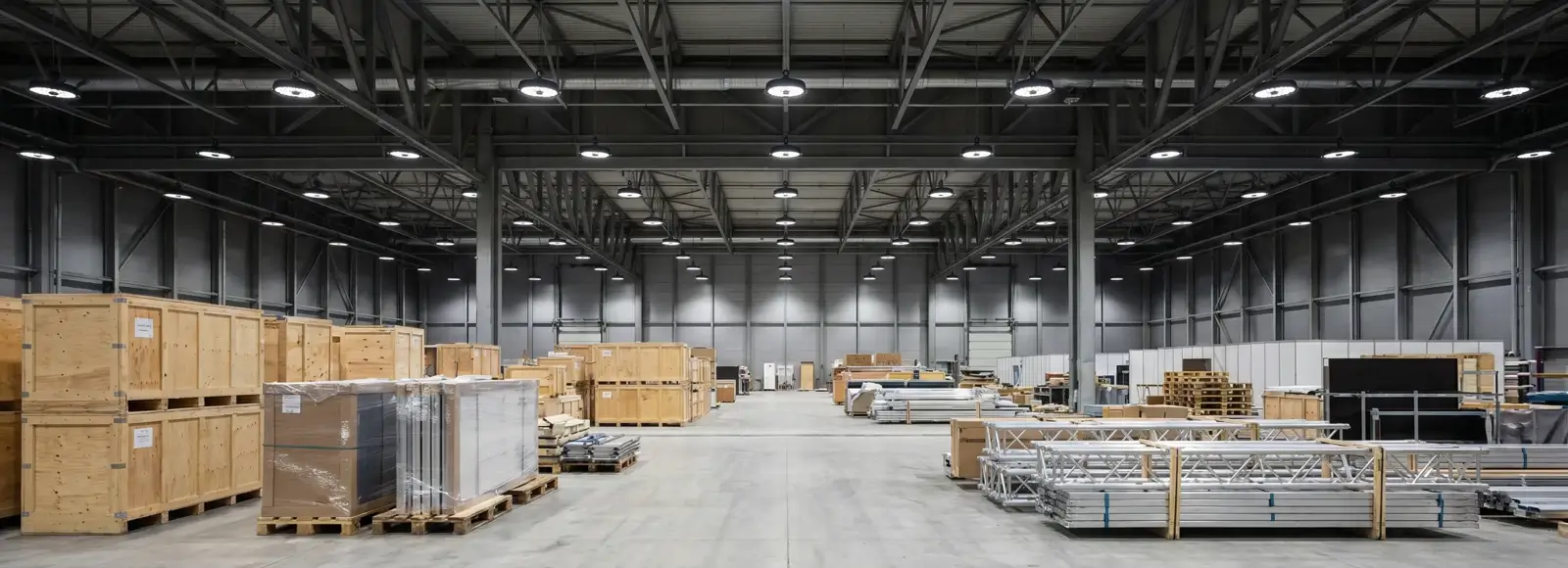
How to Choose the Right LED High Bay
1. Match mounting height to wattage
Choose fixture wattage based on mounting height: use linear high bay lights up to 100W for installations below 6 m (20 ft), 150–200W UFO or linear high bays for 8–12 m (25–40 ft), and high-output fixtures with narrow beam angles for mounting heights above 15 m (50 ft).
2. Check efficacy and lumen output
As of 2026, mainstream efficacy starts at 150 lm/W, with premium models reaching 170 lm/W. Work backward from your target illuminance:
- General storage: 150–200 lux
- Picking/packing areas: 300+ lux
- Inspection zones: 500+ lux
3. Choose the right IP and IK ratings
- Standard warehouses: IP65.
- Washdown environments: IP69K.
- Forklift-heavy zones: IK08 or higher for impact protection.
4. Select color temperature and CRI
- General warehousing: 4000K–5000K, CRI ≥70.
- Color-critical tasks: CRI ≥80.
5. Dimming and smart controls
- Single-site, basic scheduling: 1–10V dimming, simple wiring, easy control via dimmers or timers. Enough for small to mid-size warehouses.
- Multi-site, centralized management: DALI real-time monitoring of energy use, faults, and performance across all fixtures from one dashboard.
- Limited budget now, upgrade later: choose fixtures with Zhaga interfaces. Install standard lighting first, then add sensors (microwave or daylight) later, no rewiring or fixture replacement needed.
6. Thermal design and lifespan
High-quality fixtures use die-cast aluminum for heat dissipation, with L70 lifetimes of 50,000–100,000 hours (at 45°C ambient).
Always confirm that the rated lifespan matches your actual operating temperature conditions.
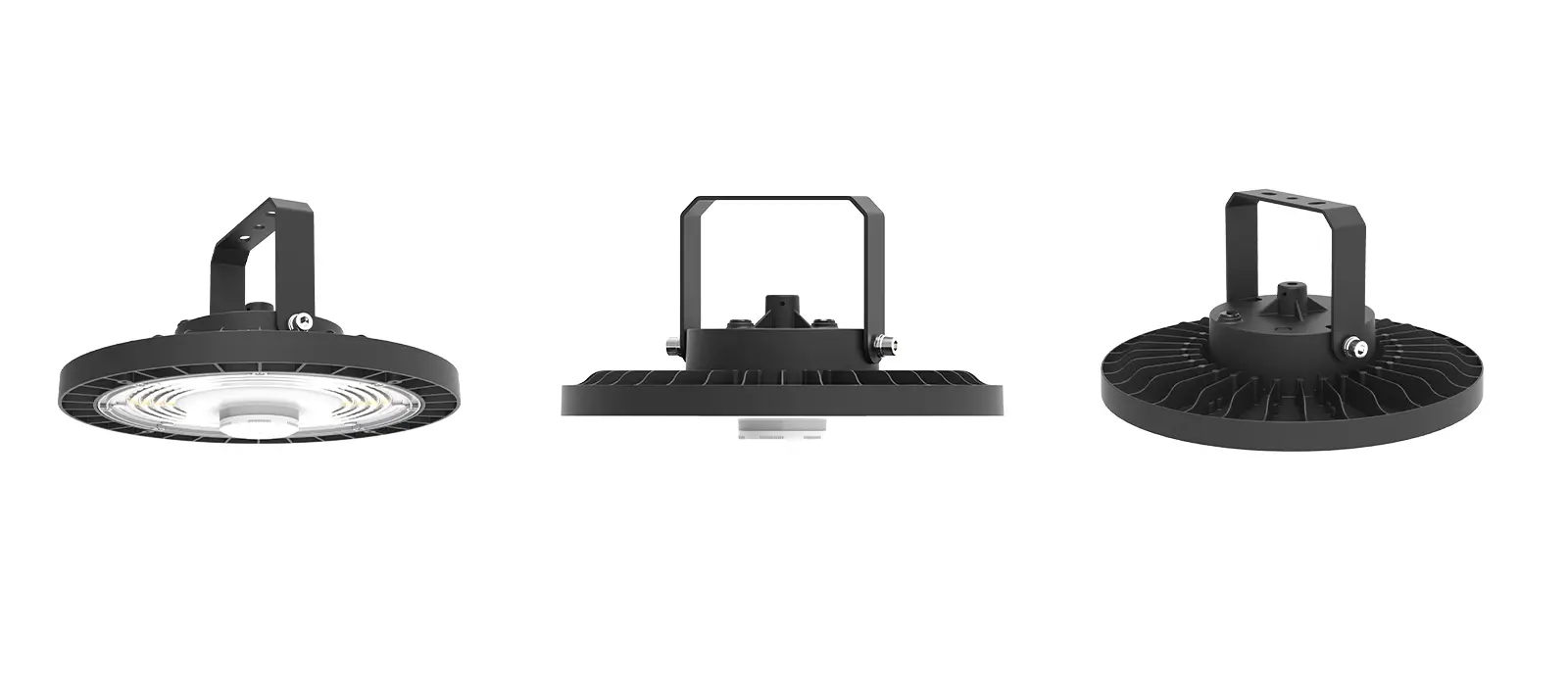
Top 5 LED High Bay Lights for Warehouses in 2026
1. TUBU F12 200W Smart Dimmable LED High Bay
F12 is a smart, adjustable LED high bay designed to handle multiple lighting scenarios with a single fixture—ideal for warehouses with varying ceiling heights and zone-specific lighting needs.
Key Features:
- Power: 200W (dimmable to 150W / 100W)
- CCT: Adjustable
- Efficacy: 150 lm/W (CRI 80) / 170 lm/W (CRI 80) / 190 lm/W (CRI 70)
- Beam Angles: 60° / 90° / 120°
- Protection Rating: IP65, IK08
- Operating Conditions: -40°C to 50°C, 50,000-hour lifespan
- Driver Protection: Short-circuit / overvoltage / thermal protection
- Dimming Control: 0–10V / PWM
- Mounting Options: Suspension / wall mount
- Control Options: Standalone microwave sensor / multi-fixture microwave sensor system
2. Philips BY698P Green Warehouse
Designed for high-rack warehouses where vertical illuminance uniformity is critical. Multiple beam angles make it easy to match different aisle widths.
Key Features:
- Power: 165W
- Efficacy: 152 lm/W (CRI >80)
- Luminous Flux: 25,000 lm
- Beam Angles: 70° / 90° / 110° / 150°
- Protection Rating: IP65, IK07
- Operating Conditions: -30°C to 50°C
- Rated Lifetime: L80 @ 50,000h (Ta 35°C)
- Dimming Control: DALI 2.0
- Mounting Options: Suspension/surface mount
- Warranty: 5 years
3. Dialight ALU1500C
Built for heavy-duty warehouses in extreme conditions—such as metal processing and petrochemical environments—where high heat and vibration are constant. Environmental durability is a standout.
Key Features:
- Power: 150W
- Efficacy: 140 lm/W (CRI >70)
- Luminous Flux: 21,000 lm
- Beam Angle: 90°
- Protection Rating: IP66, IK09
- Operating Conditions: -40°C to +65°C
- Rated Lifetime: L70 > 100,000h (Ta 55°C)
- Construction: Copper-free die-cast aluminum housing, 5G vibration rated
- Mounting Options: Suspension/wall mount
- Warranty: 10 years
4. Fanxstar A3 150W
A cost-effective choice for standard warehouses with moderate conditions and lower operational intensity—well-suited for basic lighting needs.
Key Features:
- Power: 150W
- Efficacy: 150 lm/W (CRI >80)
- Luminous Flux: 22,500 lm
- Beam Angles: 90° / 120°
- Protection Rating: IP65, IK06
- Operating Conditions: -20°C to +45°C
- Rated Lifetime: L70 @ 54,000h
- Dimming Control: 1–10V
- Mounting Options: Suspension/surface mount
- Warranty: 5 years
5. Access Fixtures UPTA 120W
A practical entry-level option for small warehouses with limited budgets and mild operating conditions. Low upfront cost and easy one-person installation.
Key Features:
- Power: 120W
- Efficacy: 130 lm/W (CRI >80)
- Luminous Flux: 15,600 lm
- Beam Angle: 120° (fixed)
- Protection Rating: IP65 (no IK rating specified)
- Operating Conditions: -10°C to +40°C
- Dimming Control: 1–10V (not available on all versions)
- Mounting Options: Suspension/surface mount
- Warranty: 3 years
About TUBU
In industrial lighting, reliability is proven over time.
Since 2014, TUBU has focused on LED lighting manufacturing, building a comprehensive testing system that covers integrating sphere photometric testing, salt spray testing, vibration testing, and IP-rated dust and water protection. Every product is validated through these processes before market release—ensuring long-term performance in warehouse, logistics, and industrial environments.
We offer a standard 5-year warranty and provide free Dialux lighting simulations, allowing projects to verify lighting performance during the design phase and reduce deployment risk.
If your project requires a stable, long-lasting lighting solution, TUBU’s engineering team can support you with tailored product selection and technical guidance. Request the 2026 product catalog to explore more solutions.
Installation & Maintenance Tips
Mounting Height and Spacing Alignment
In low-ceiling spaces below 6 m (20 ft), keep fixture spacing within 1.2× the mounting height, with linear high bays arranged along the aisle direction.
In mid-to-high ceilings of 8–12 m (25–40 ft), spacing can extend to 1.5× the mounting height, typically using UFO high bays in a grid layout.
For ultra-high ceilings above 15 m (50 ft), use narrow-beam, high-output fixtures, with spacing determined through photometric simulation based on the light distribution curve.
Choosing Between Suspension and Wall Mounting
For open, unobstructed warehouse ceilings, suspension mounting is the preferred option as it delivers the highest light utilization. In areas with wall-side racking or low mezzanines, wall mounting is more suitable to prevent light from being blocked by forklifts or stored goods.
Always verify the load capacity of suspension hardware, and for fixtures over 5 kg (11 lbs), use a safety cable as secondary protection.
Sensor Placement Guidelines
Microwave sensors should be installed at 80%–100% of the fixture height, while avoiding direct alignment with metal racks or ventilation ducts to prevent false triggering caused by signal reflections.
For networked daylight (constant illuminance) sensors, placement in mid-warehouse areas with weaker natural light is recommended, providing a stable reference point for maintaining consistent lighting levels.
Routine Maintenance Intervals
Check fixture surfaces for dust buildup every six months; in high-dust environments such as building materials or grain storage, shorten this to quarterly cleaning. Every two years, sample-check driver output to ensure actual power does not deviate more than 10% from rated values.
After storm seasons, test surge protection modules for remaining capacity; fixtures rated above 6 kV surge protection can typically follow extended inspection intervals.
FAQs
1. What wattage high bay lights do you need for a warehouse?
The simplest way is to size by ceiling height:
- 4–6 m (13–20 ft): 100–150W
- 6–9 m (20–30 ft): 150–200W
- 9–15 m (30–50 ft): 200–300W
These ranges assume standard beam angles of 60°–120°. If you use a narrow beam (≤60°), you can reduce wattage slightly; with a wide beam (≥120°), increase lumen output accordingly to maintain the required illuminance.
2. How many lumens per square meter do you need?
For general warehouse areas, plan for 200–300 lux. A quick estimate for total lumen output is: total area (m²) × target illuminance (lux) ÷ 0.48 (accounting for utilization and light loss factors), which gives you the required total lumens.
3. UFO vs Linear High Bays — How to Choose
For open storage or unobstructed spaces, UFO high bay lights are the better choice. For warehouses with aisle-based racking systems, linear high bays provide more uniform, directional lighting. In facilities that combine both layouts, a mixed configuration is typically the most effective solution.
4. Can LED high bay lights be used in cold storage warehouses?
Yes—but only if the fixture is rated for low-temperature operation, typically down to -20°C or even -30°C. TUBU high bay and linear lighting products are designed to operate in environments ranging from -20°C to +40°C.
5. How long do LED high bay lights last?
In industry, lifespan is typically defined by L70, meaning the point at which light output drops to 70% of its original level.
Under standard operating conditions, most LED high bay lights offer an L70 lifespan of 50,000–100,000 hours. Some premium models may reach higher figures under controlled test conditions, but actual service life still depends heavily on ambient temperature and thermal management performance.
Conclusion
Selecting LED high bay lights for warehouses is ultimately about aligning technical specifications with real-world operating conditions. Mounting height determines wattage selection, the working environment defines the required protection level, and operational scale drives the choice of smart control systems.
For specific project needs, feel free to contact TUBU—our engineering team is ready to provide one-on-one technical support.