
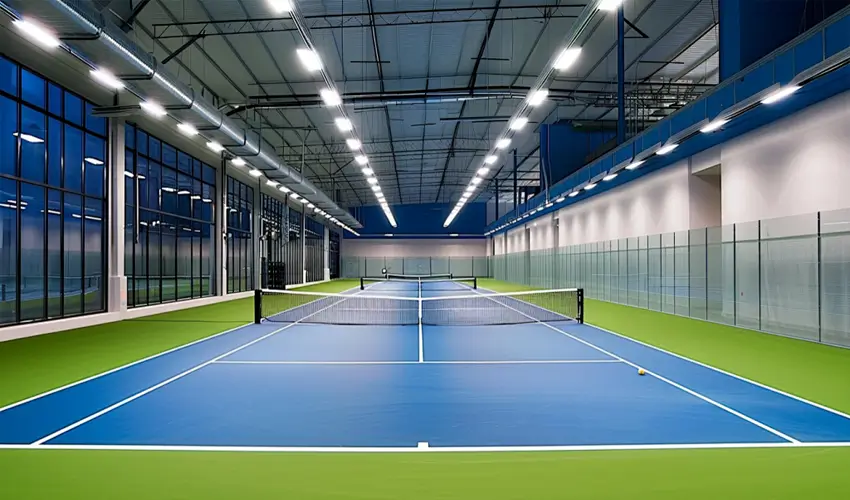

Tennis court lighting projects are challenging because they look simple on the surface but are easy to get wrong in practice. Installing a few high-output fixtures is not difficult—the real challenge is achieving a stable and controllable lighting performance across the entire court.
As a professional manufacturer with 12 years of expertise in industrial LED high-bay lighting, TUBU understands that lumen output is only the entry ticket—optical control is where the real game begins. Next, we’ll break down a tennis court lighting solution from an engineering implementation perspective.
Key Design Considerations for Tennis Court Lighting
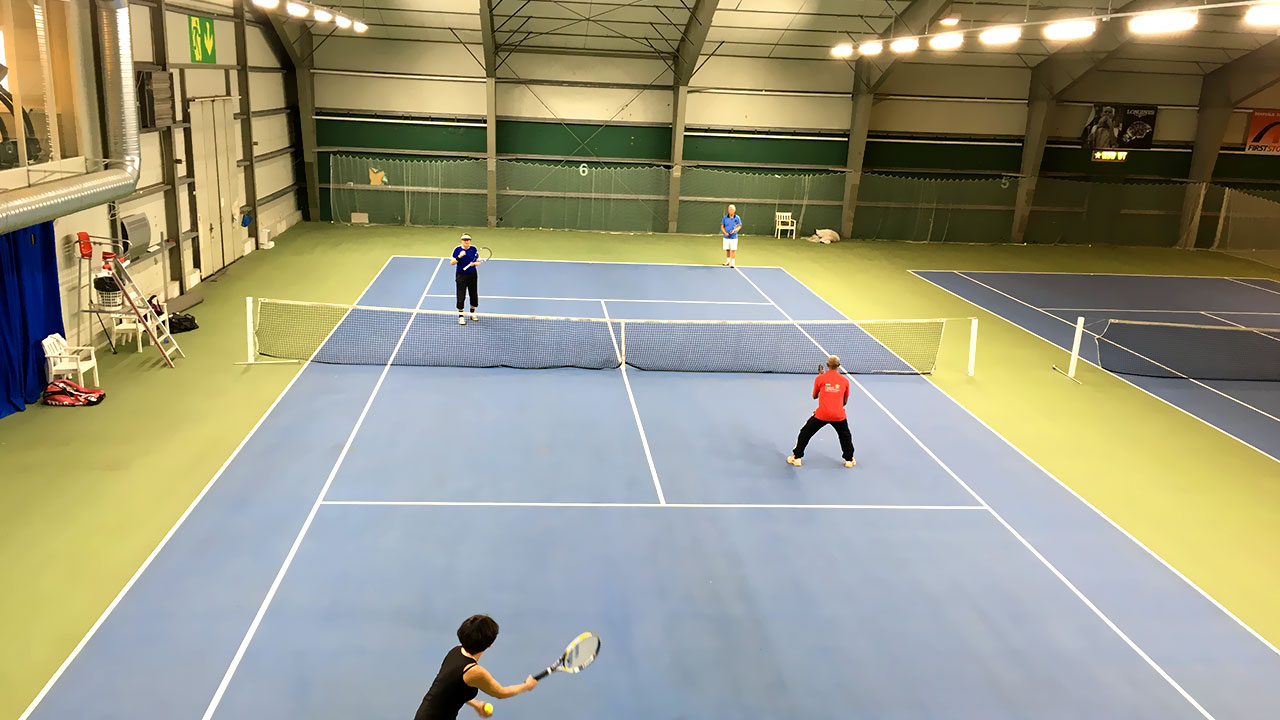
Many electrical contractors tend to apply warehouse lighting design principles directly to tennis court projects. This approach is fundamentally flawed—like taking a family sedan into an off-road rally, where its limitations quickly become obvious. Warehouse lighting is primarily focused on vertical illuminance for shelving, while tennis court lighting is centered on enabling players to clearly track a fast-moving ball trajectory.
Illumination Uniformity vs. Average Illuminance
In engineering acceptance standards, illumination uniformity on tennis courts—U1 (minimum illuminance / maximum illuminance) and U2 (minimum illuminance / average illuminance)—is far more critical than a single average lux value. According to the IESNA RP-6-20 recommendations, club-level courts should maintain a U2 value of no less than 0.7.
When the human eye moves rapidly across the court, uneven lighting with alternating bright and dark patches forces the pupil to adjust constantly. This natural response can lead to a brief visual disruption within a critical 0.2-second window—the exact time frame that determines whether a serve is judged in or out.
For this reason, the photometric distribution of LED high bay luminaires must be precisely matched to the court’s aspect ratio. We strongly recommend performing a simulation in Dialux or AGI32 to optimize luminaire placement, ensuring that the illuminance gradient along the baseline does not exceed 20% per meter.
Glare Control Within the Player’s Line of Sight
Tennis courts present a unique challenge: luminaires are typically installed within the natural upward viewing range of players during serves (approximately 30°–60° elevation angle). In conventional industrial high-bay lights, the light source is often exposed, and uncontrolled high-angle spill light can directly enter the retina, thereby driving the Unified Glare Rating (UGR) above 28.
From an engineering perspective, it is recommended to use LED high bay fixtures equipped with precision louvers or deep-recessed optical lenses—such as linear luminaires with multi-faceted anti-glare PC optics. These designs can suppress light intensity above 65° to a very low level, reducing on-site UGR to 19 or even 16, achieving a “light without glare” visual comfort standard.
Beam Angle and Installation Geometry
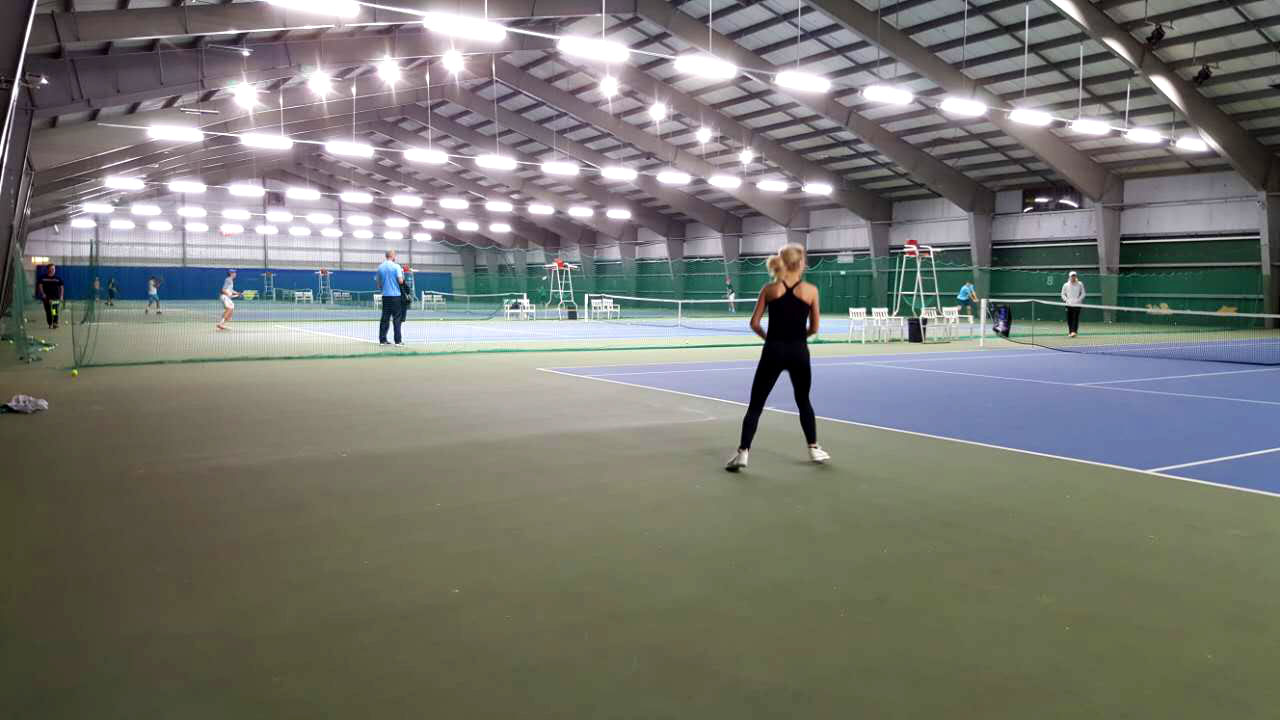
Whether a tennis court LED high bay lighting system performs effectively comes down to the alignment of two key photometric parameters: beam angle and mounting height. From a photometric standpoint, these two factors jointly determine the overlap pattern of light on the playing surface.
Once pole positions are fixed, any mismatch in beam angle selection will directly result in either irreversible dark zones or excessive light spill. Post-installation dimming controls can only adjust output intensity—they cannot correct the spatial distribution of light.
Beam Angle Selection Based on Mounting Height
- Indoor courts (8–12 m ceiling height): A beam angle of 60° or 90° is recommended. Wider beams allow rapid overlap of light pools at lower mounting heights, eliminating “hot spots and dark gaps.” If a narrow beam is used at this height, it will create isolated high-intensity pools on the floor while leaving surrounding areas underlit.
- Outdoor courts (pole height 12–18 m): A beam angle of 30° or 60° is preferred. Higher mounting positions require narrower beams to counteract the inverse square law, ensuring sufficient vertical illuminance to clearly illuminate the ball at the peak of its flight path.
Pole Setback and Aiming Angle
Based on fundamental photometric principles, the following installation guidelines should be strictly followed:
Pole setback distance: The horizontal distance from the pole centerline to the doubles sideline projection should be maintained between 3.5 m and 5 m. Too close will cause overexposure near the lighting side; too far will create an undesirable dark zone along the net center area.
Aiming angle: The recommended tilt angle for luminaires is 25° ± 5°. Mounting high bay lights at a 0° vertical downward angle is strictly discouraged—it will only produce a perfect spotlight on the ground and leave the baseline area in complete darkness.
Key Product Specification Parameters
From an engineering execution perspective, evaluating an LED high bay fixture should go far beyond luminous efficacy alone. The real focus is on how the product performs under harsh, real-world operating conditions.
System Efficacy and Thermal Management
Indoor courts
Recommended fixtures should deliver a system efficacy of 170–190 lm/W, combined with deep anti-glare louvers in linear high bay formats. These luminaires are typically equipped with low-glare optical lenses and support 1–10V or DALI-2 dimming protocols, allowing seamless integration into building automation systems.
During non-competition periods, output can be smoothly dimmed down to 30%, maintaining sufficient training-level illuminance while significantly reducing energy consumption. Flicker-free design also ensures clean, stable imaging for high-speed camera recording.
Outdoor courts
Recommended solutions include high-power high bay luminaires made from die-cast aluminum housings with rigorous salt-spray corrosion protection. Wide voltage input (100–277 VAC) ensures stable performance under grid fluctuations.
An optimized airflow-based thermal design helps maintain LED junction temperature within a safe range across an operating temperature span of -40°C to +50°C. This ensures lumen depreciation remains tightly controlled throughout a service life of up to 50,000 hours.
Protection Structure
A tennis court is essentially a continuous mechanical stress environment for lighting fixtures. Ball impact speeds can reach up to 200 km/h, occasionally accompanied by accidental racket strikes. For this reason, an IK10 impact resistance rating is a non-negotiable requirement.
For semi-outdoor or fully exposed installations, an IP66 or higher protection rating is essential to prevent moisture ingress into the driver compartment and avoid uncontrolled maintenance costs over the project lifecycle.
In addition, integrated surge protection (6–10 kV) provides effective resistance against induced lightning surges during thunderstorms, ensuring long-term system reliability.
Pre-Installation Verification
Don’t let the subjective feeling of “it looks bright enough” become the sole acceptance criterion. Lighting performance should be validated through photometric data—not perception.
Dialux Simulation and IES File Review
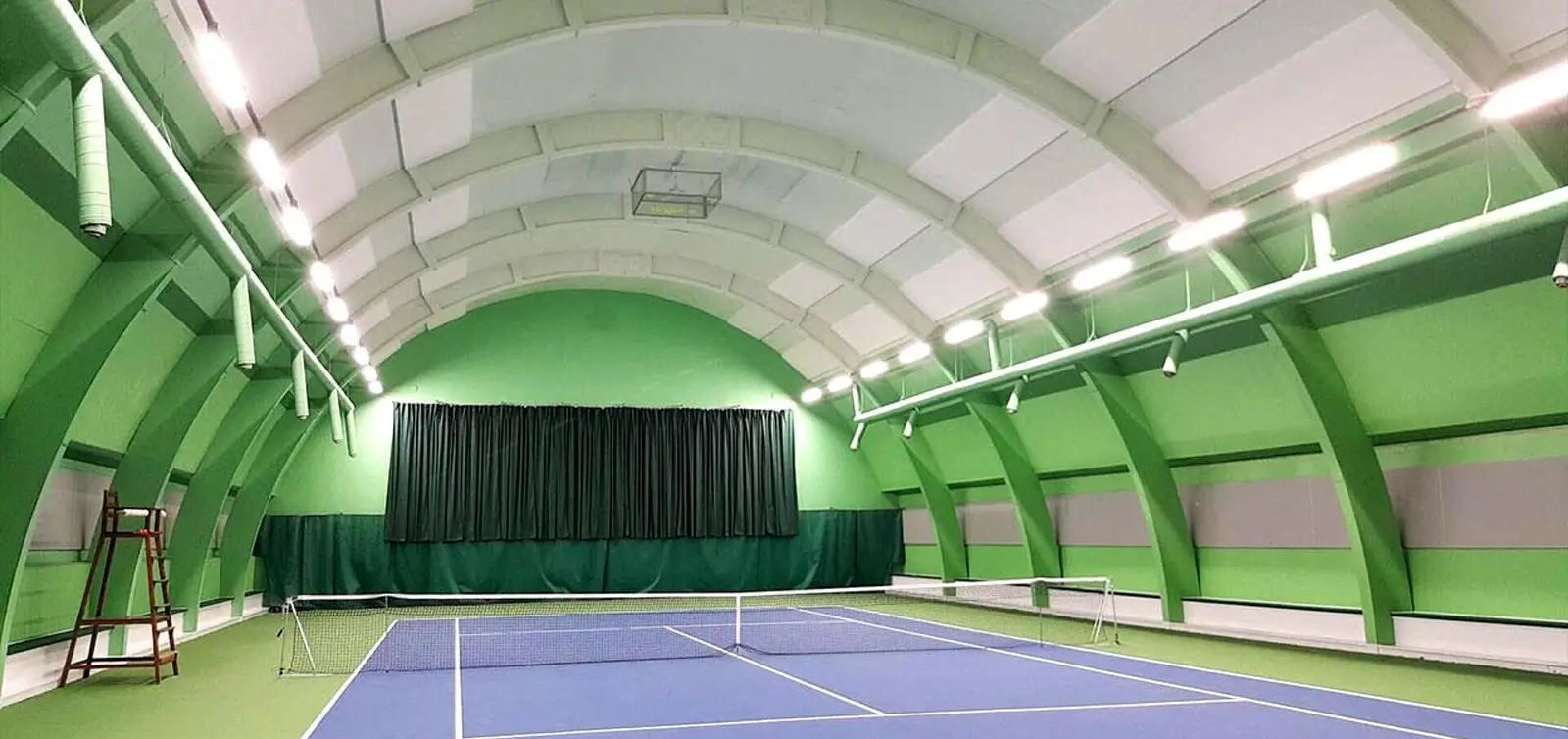
Before pouring concrete for any pole foundation, the supplier must provide a Dialux lighting simulation report based on accurate CAD drawings. This report uses false-color renderings to precisely display lux values at every grid point across the court.
It allows early detection of “saddle-shaped” dark zones caused by excessive pole spacing—preventing situations where a dim strip unexpectedly appears between two lighting fixtures after installation is completed.
Flicker Compliance for Broadcast-Grade Courts
For courts equipped with Hawk-Eye systems or designed for high-definition broadcasting, the LED driver ripple current must be strictly controlled. Industry standards require flicker levels compliant with IEEE 1789, with flicker percentage kept below 5%.
High-quality constant-current LED drivers ensure that under high-frame-rate slow-motion playback, no rolling dark bands appear in the captured footage. This is a non-negotiable requirement for professional-level sports broadcasting.
Conclusion
Tennis court LED high bay lighting design is a multidisciplinary engineering practice involving geometric optics, thermodynamics, and structural mechanics. A successful lighting system is not something players consciously notice—it is something they stop noticing altogether.
From the very first minute on court, players should experience the lighting without distraction. When they fully forget about the fixtures overhead and focus entirely on tracking every ball, the project can be considered truly successful.
If you are currently planning a tennis court project and have technical questions regarding beam angle simulation, IES photometric file matching, or on-site layout validation, feel free to contact the TUBU engineering team at any time.