
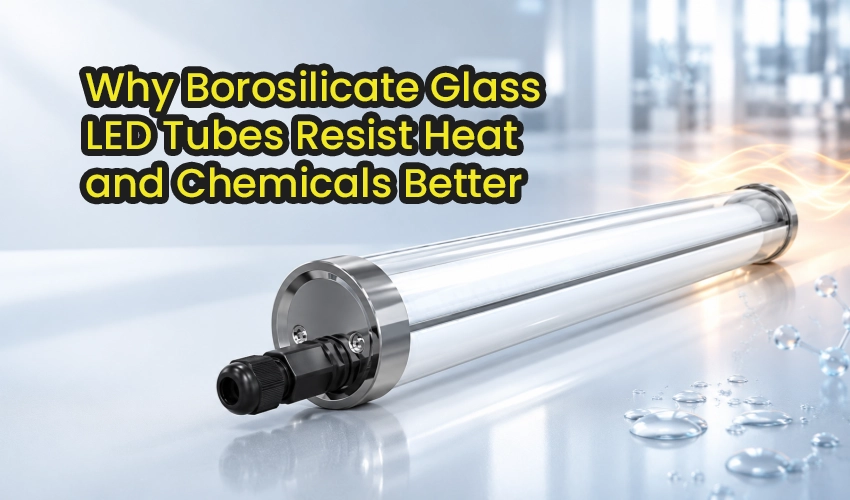

Borosilicate glass LED tubes offer better resistance to heat and chemical exposure than standard glass or plastic alternatives. Their low thermal expansion and strong chemical stability help maintain structural integrity in demanding environments, such as food processing plants, laboratories, and industrial facilities.
Understanding these properties helps lighting buyers choose durable fixtures with lower maintenance needs and a longer service life.
Why Thermal Shock Matters for LED Tubes
Imagine a cold washdown spray hitting a warm lamp, or equipment cycling from daytime heat to nighttime cold. Those sudden swings are common in industrial and marine settings. Standard polycarbonate (PC) tubes expand and contract more under temperature changes, so they can develop stress cracks or micro-fractures.
Borosilicate glass has a much lower coefficient of thermal expansion. That means it stays dimensionally stable during rapid shifts, which reduces the risk of cracking at seals. The LED tube stays structurally intact over time.
For procurement teams, fewer replacements and less downtime matter. That’s especially true in food processing areas with hot rinse cycles, outdoor marine walkways, or storage facilities with large bay doors.
Chemical Vapors and Cleaning Agents
Some facilities expose lighting to chemical vapors, solvents, or aggressive cleaning detergents. The tube material has to hold up. PC can be attacked by certain chemicals, leading to surface crazing, yellowing, or a loss of mechanical strength.
Borosilicate glass is chemically inert. It resists a broad range of acids, bases, and organic solvents. Even after repeated contact with sanitizing chemicals, the surface stays clear and smooth, which helps maintain consistent light output.
That’s why glass LED tubular lights make sense in chemical processing areas, pharmaceutical cleanrooms, and any facility that regularly uses washdown chemicals.

Humidity, Clarity, and Long-Term Light Output
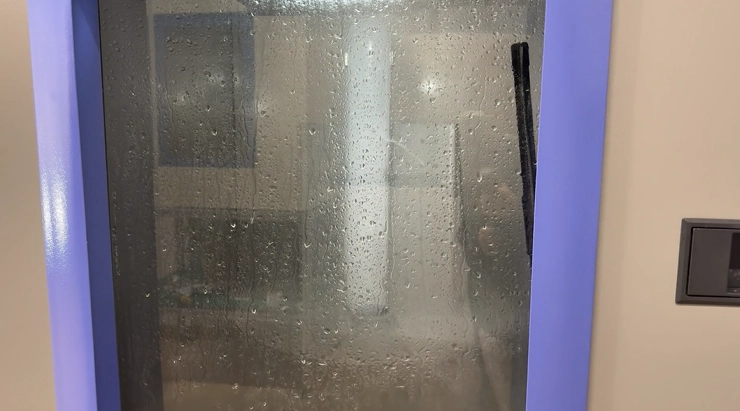
High humidity and condensation are common in marine, coastal, and food/beverage environments. Some polymer tubes absorb moisture over time, which can lead to optical haze or internal fogging. Glass doesn’t absorb water, so a borosilicate glass tube is less likely to develop cloudy interiors or degrade from prolonged moisture exposure.
Keeping the optical path clear matters for preserving lumen output and beam quality.
When you’re evaluating tubular lights for damp or wet locations, don’t just look at the fixture’s sealing. Think about how the tube material interacts with the environment. A glass tube adds another layer of long-term stability in humid conditions.
Selecting Glass LED Tubular Lights for Demanding Sites
Borosilicate glass has clear advantages, but you still need to look at the whole fixture: housing corrosion resistance, sealing integrity, driver reliability, and any certifications required for your region or application.
Glass tubes are heavier than PC alternatives, so mounting and handling practices need to match the fixture design. And always verify that the manufacturer’s stated environmental ratings line up with the actual installation conditions.
If you’re specifying lighting for thermal shock, chemical vapor, or high humidity environments, include borosilicate glass LED tubes in the project specs alongside standard PC options.
FAQ
Q: What is the main advantage of borosilicate glass over PC for LED tubes?
A: The main advantage? It has a much lower thermal expansion coefficient and better chemical inertness. That means fewer cracks from thermal shock and less surface damage from cleaning chemicals or solvent vapors.
Q: Are borosilicate glass LED tubes suitable for high humidity or marine areas?
A: Yes. Unlike some polymers, glass doesn’t absorb moisture, so it helps keep the optical path clear and light output consistent in humid or salt-laden air.
Q: Do glass LED tubular lights require special handling during installation?
A: They’re more brittle than polycarbonate, so avoid impacts during transport and mounting. Once installed in a properly designed fixture, they offer long-term dimensional stability and chemical resistance.
Q: Can borosilicate glass LED tubes be used in food processing or pharmaceutical facilities?
A: They’re often preferred when washdown chemicals, thermal cycling, or strict hygiene rules are in play. But always check that the specific fixture and its seals meet your local sanitation and safety standards.