

When choosing floodlights, many people tend to focus only on power or price. However, in practical use, issues such as rapid brightness decay, frequent failures, and poor lighting performance often arise, making the product unsuitable for real-world applications.
Therefore, product quality should be the top priority when selecting a floodlight.
So, how can you professionally assess the quality of an LED floodlight? Drawing on 12 years of engineering and R&D experience at TUBU, this article systematically analyzes the key evaluation criteria from multiple core dimensions to help you make a more reliable choice.
1. Key Factors Determining the Quality of LED Floodlights
When selecting an LED floodlight, evaluating product quality can be done comprehensively by considering the following core dimensions:
- Lifespan & Reliability
- Optical Performance
- Electrical Performance
- Structural Design
- Features & Applications
- Protection Rating
- Electrical Safety
The following sections provide a detailed analysis of these dimensions, helping you assess the quality of an LED floodlight.
2. Lifespan & Reliability
2.1 Lifespan
Lifespan is one of the key indicators for evaluating the quality of an LED floodlight. It not only determines whether the fixture can operate reliably over the long term but also directly affects maintenance costs and overall value.
According to current industry standards, high-quality products can typically achieve 80,000–100,000 hours under a Ta of 45°C. This indicates that even after tens of thousands of hours of operation at 45°C, the fixture maintains consistent light output, reflecting strong long-term reliability.
Additionally, in practical applications, lifespan should be assessed in combination with the actual operating temperature of the environment.
2.2 Lumen Depreciation
Lumen depreciation refers to the gradual reduction in light output of an LED over time and is a key indicator of long-term performance. It is commonly expressed using metrics such as L70 or L80, which indicate the point in time when the light output decreases to 70% or 80% of its initial level. The longer it takes to reach these thresholds, the slower the lumen depreciation and the better the fixture's stability and overall performance.
3. Optical Performance
3.1 Luminous Efficacy
Luminous efficacy is one of the key indicators for evaluating the performance of an LED floodlight. The higher the efficacy, the more light output is produced at the same power consumption, resulting in better energy efficiency.
Therefore, when selecting a fixture, comparing the luminous efficacy of different products under the same wattage can provide a useful initial indication of overall quality.
3.2 Color Rendering Index (CRI)
The Color Rendering Index (CRI) is an important metric for evaluating a light source’s ability to accurately reproduce the true colors of objects. For LED floodlights, CRI directly affects the visual quality of the illuminated environment. It is typically expressed as the average CRI (Ra), with above 70–80 considered standard for most applications.
4. Electrical Performance Parameters
4.1 Power Factor (PF)
Power Factor (PF) is an important indicator of how efficiently electrical energy is converted into useful output. It ranges from 0 to 1, with higher values indicating lower energy losses.
When selecting an LED floodlight, it is recommended to prioritize products with a PF of 0.9 or higher to ensure efficient energy use and reduce unnecessary power wastage.
4.2 Input Voltage Range
The input voltage range specifies the AC voltage interval within which an LED floodlight can operate safely and reliably. It is usually expressed in VAC.
The wider the input voltage range, the more adaptable a floodlight is to variations in the power supply. Typical regional mains voltages include 100–120V AC in North America and 220–240V AC across Europe and Asia, so a wide voltage range ensures reliable operation in different regions.
For example, our TG4 floodlight supports an input voltage of 100–240/277V AC (50/60Hz), allowing it to operate reliably across most power grids worldwide. Therefore, when evaluating the quality of an LED floodlight, products with a wide input voltage range generally offer better compatibility and electrical stability, making them particularly suitable for export projects or complex electrical environments.
5. Mechanical Design
The mechanical design, particularly the heat dissipation structure, directly affects the overall lifespan and lumen depreciation of an LED floodlight.
High-quality LED floodlights typically feature die-cast aluminum housings, which provide superior thermal conductivity and structural strength compared to other materials, ensuring long-term stable operation.
6. Functionality and Application Capability
6.1 Features
The feature set of an LED floodlight is an important factor in evaluating its level of intelligence and adaptability to different applications. High-quality LED floodlights typically support multiple optional functions such as 0–10V or 1–10V dimming, timer control, photocell/light sensing, and IoT-enabled smart control.
6.2 Modular Connectivity
Modular connectivity is an important factor in evaluating an LED floodlight’s adaptability for high-power and large-scale projects.
LED floodlights with a modular design consist of multiple independent units that can be combined according to specific project requirements. Each module typically contains its own light source, driver, and heat dissipation structure. By connecting modules, a higher-power or larger-coverage lighting system can be created.
Compared to traditional one-piece fixtures, modular designs offer greater flexibility:
- Power can be adjusted by combining modules as needed, from single-module to multi-module high-power configurations.
- Different beam angles can be combined to achieve precise light distribution.
- Ideal for large-area lighting applications such as stadiums, plazas, and building facades.
In addition, modular designs improve maintenance convenience. If a single module fails, it can be replaced individually without replacing the entire fixture, reducing maintenance costs and downtime.
7. Protection Ratings
Protection ratings are a key parameter in evaluating the quality of a floodlight. LED floodlights are commonly used in large-scale or outdoor projects such as stadiums, construction sites, bridges, and tunnels. These fixtures are not only exposed to harsh environmental conditions but must also withstand dust, vibration, and temperature fluctuations, while maintaining stable performance and low maintenance requirements.
Therefore, high-quality LED floodlights typically feature IP66 and IK08-IK11 protection, along with excellent high-temperature and corrosion resistance. These characteristics ensure long-term reliable operation in demanding environments and help minimize maintenance costs.
8. Electrical Safety Protection
Lightning and surge protection refers to an LED floodlight’s ability to withstand transient high-voltage surges, preventing damage to the fixture. The level of protection is typically assessed based on surge rating (kV), driver quality, and grounding design.
In practical applications, a significant portion of floodlight failures are related to surge voltages, making surge protection a critical factor in evaluating product reliability. Common sources of voltage surges include:
- Grid fluctuations caused by lightning strikes
- Switching operations in the power network, such as the startup or shutdown of large equipment
- Transformer switching
These events can generate transient high-voltage surges reaching several kilovolts. Without effective surge protection, the driver or even the entire fixture can be damaged, leading to system failure.
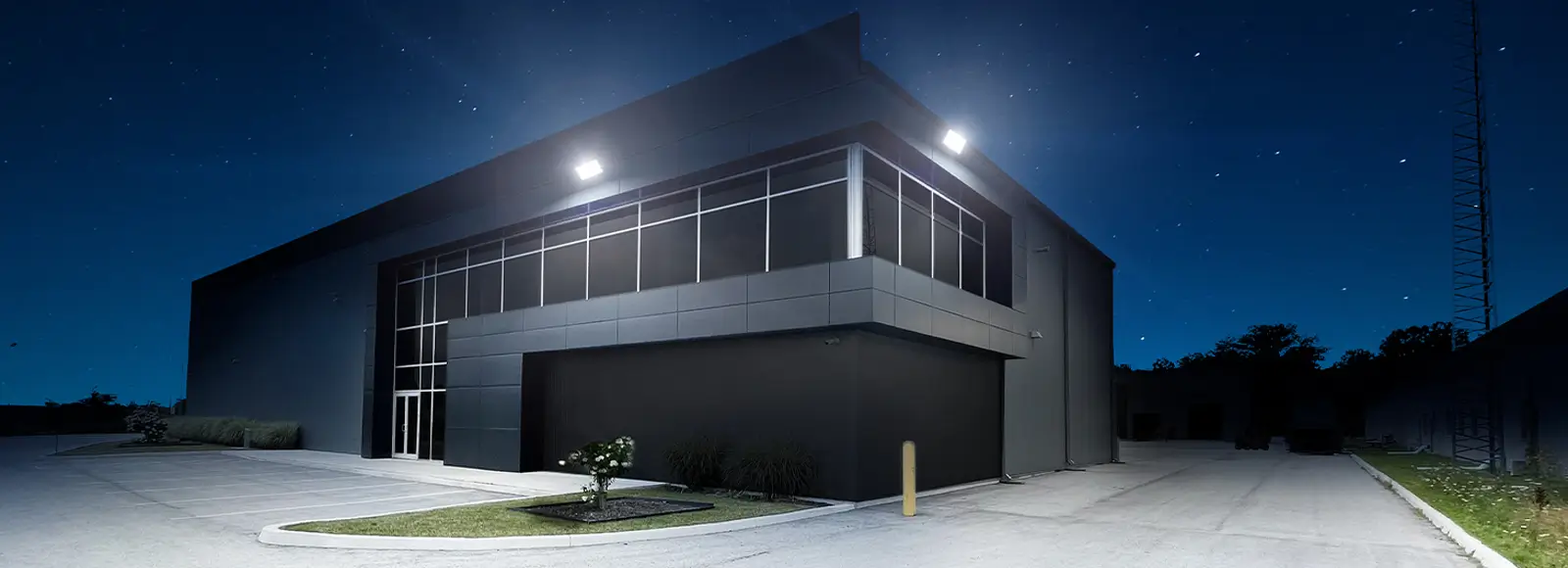
9. How to Select High-Quality LED Floodlights
When selecting high-quality LED floodlights, the first consideration should be their protection capabilities, including water and dust resistance, impact resistance, and high-temperature and corrosion resistance. These factors form the foundation for determining whether a fixture can operate reliably over the long term in various project environments.
High-quality products typically achieve a lifespan of L70 ≥ 80,000 hours. Combined with effective heat dissipation, surge protection, and modular connectivity, these features allow for a comprehensive assessment of long-term stability, helping to reduce future maintenance costs.
Next, comparing luminous efficacy (lm/W), color rendering index (CRI, Ra), and power factor (PF) helps evaluate the lighting and energy efficiency of the fixture.
Additionally, examining the range of adjustable beam angles, input voltage range, and dimming functions provides insight into the fixture’s flexibility and adaptability for different project requirements.
For example, the TUBU TG4 LED floodlight features a streamlined housing with drainage holes for improved water-shedding performance while maintaining optimal heat dissipation. The rear cover allows local wiring and adjustment of power, color temperature, and light-sensing functions without opening the entire fixture. Additional features include long service life, tempered high-temperature glass, surface coating for corrosion resistance, and robust durability, making it suitable for a wide range of project applications.
10. Conclusion
Selecting LED floodlights that meet high-quality standards not only ensures long-term reliable operation but also reduces maintenance costs and improves energy efficiency.
For example, when planning lighting for a warehouse or construction site, by considering these key factors in the context of your project, you can make a more informed decision and choose high-quality, reliable LED floodlights that deliver optimal illumination and long-term performance.
If you are still unsure about selecting the right fixtures, feel free to contact us. TUBU’s professional engineers will provide the most suitable lighting solutions for your project.